WhatsApp Now
 +(91) 8700778618

Most websites still ignore meta descriptions. Even today, a large number of top-ranking pages either leave them blank or treat them as an afterthought.
That’s a mistake.
Meta titles and meta descriptions may not be visible on your page, but they heavily influence how search engines understand your content and how users decide whether to click your result. They sit at the intersection of SEO and user behavior.
This guide focuses on how meta title tags actually work in modern search. Not just for rankings, but for visibility, clarity, and clicks across Google and AI-driven search experiences. We will break down what matters, what no longer does, and how to write meta titles and descriptions that stay effective as search continues to evolve.
What is a Meta Title in SEO?
A meta title, often called a page title or title tag, is the main title of a page that appears in search results and browser tabs. It is defined in the HTML <head> section of a page and tells search engines what the page is about.
You may hear it referred to as a meta title tag, page title, or simply a title. While the term “meta” is not technically correct from a pure HTML standpoint, it is widely used in SEO and understood as part of a page’s metadata.
In practical terms, the meta title is one of the strongest on-page signals for relevance. It helps search engines categorize your content and strongly influences whether a user clicks your result.
How do I craft a meta title that converts?
Writing a meta title is harder than it looks. Anyone can describe a page. Very few can write a title that earns the click.
That’s because a strong meta title is both logic and psychology. It needs to explain what the page is about while giving users a reason to choose you over ten other results. This is where most pages fail.
Here are the principles that consistently work.
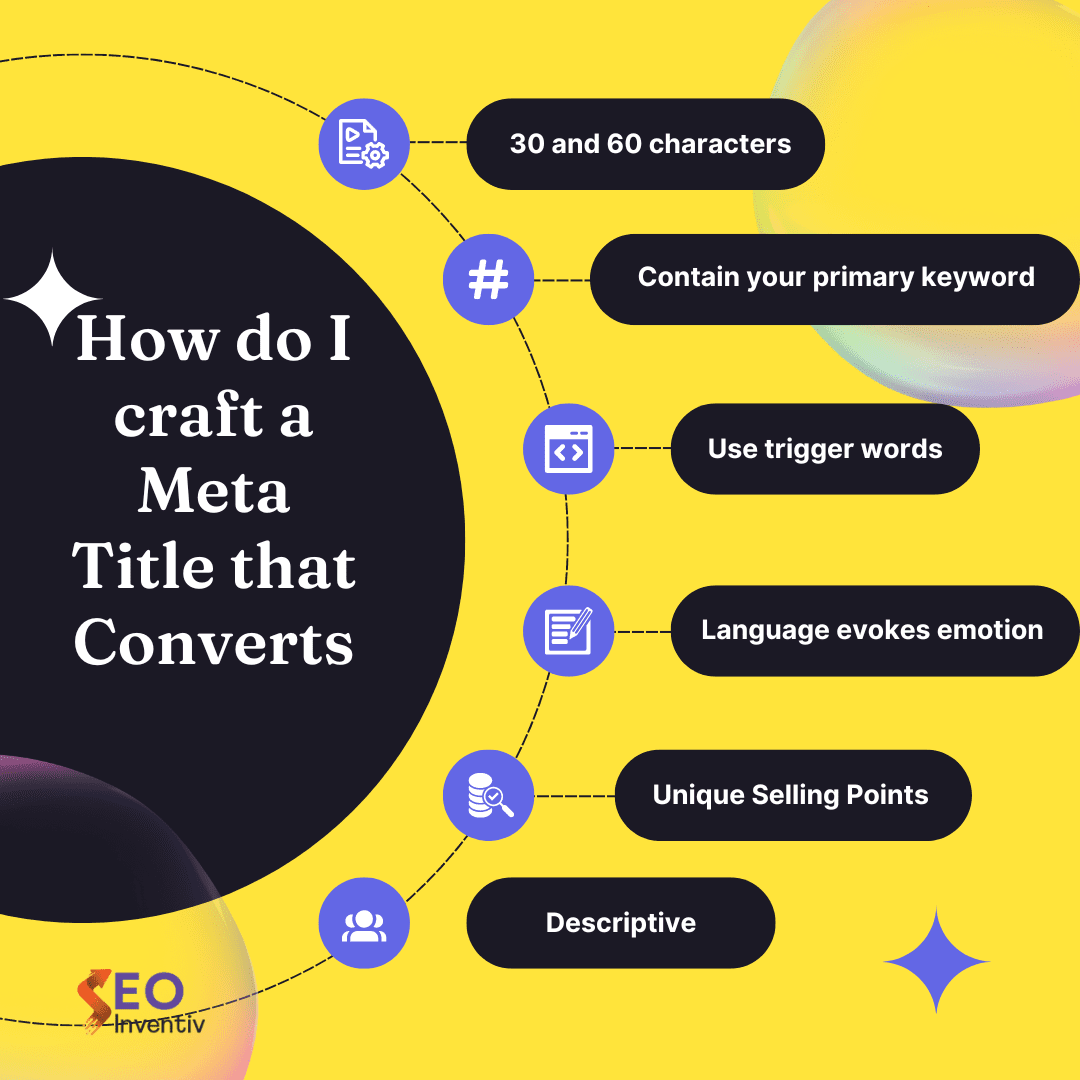
- A meta title should stay within a readable range, usually between 30 and 60 characters. This helps prevent truncation and keeps the message clear in search results.
- Your primary keyword should be present, but it must feel natural. Search engines look for relevance, while users look for clarity.
- Words that signal value or urgency can improve click through rates when used carefully. Terms like learn, grow, free, exclusive, or limited work because they speak directly to user intent, not because they are tricks.
- Strong meta titles also highlight a clear differentiator. This could be expertise, speed, certification, pricing clarity, or a specific outcome. If your title does not answer “why this result,” it usually gets ignored.
Meta Title Checklist
You can build the best page on your website and still lose clicks if your meta title doesn’t do its job. In search results, the title is often the first—and sometimes only—element users see before deciding where to click. That’s why following proven meta title best practices is critical for improving click-through rates and overall search performance.
Effective meta title best practices focus on clarity, relevance, and intent matching. A well-crafted title not only signals value to users but also helps search engines understand the page’s purpose, turning impressions into actual traffic.
A good meta title sets expectations. A weak one gets ignored.
Use this checklist to make sure your titles are clear, relevant, and built to compete.
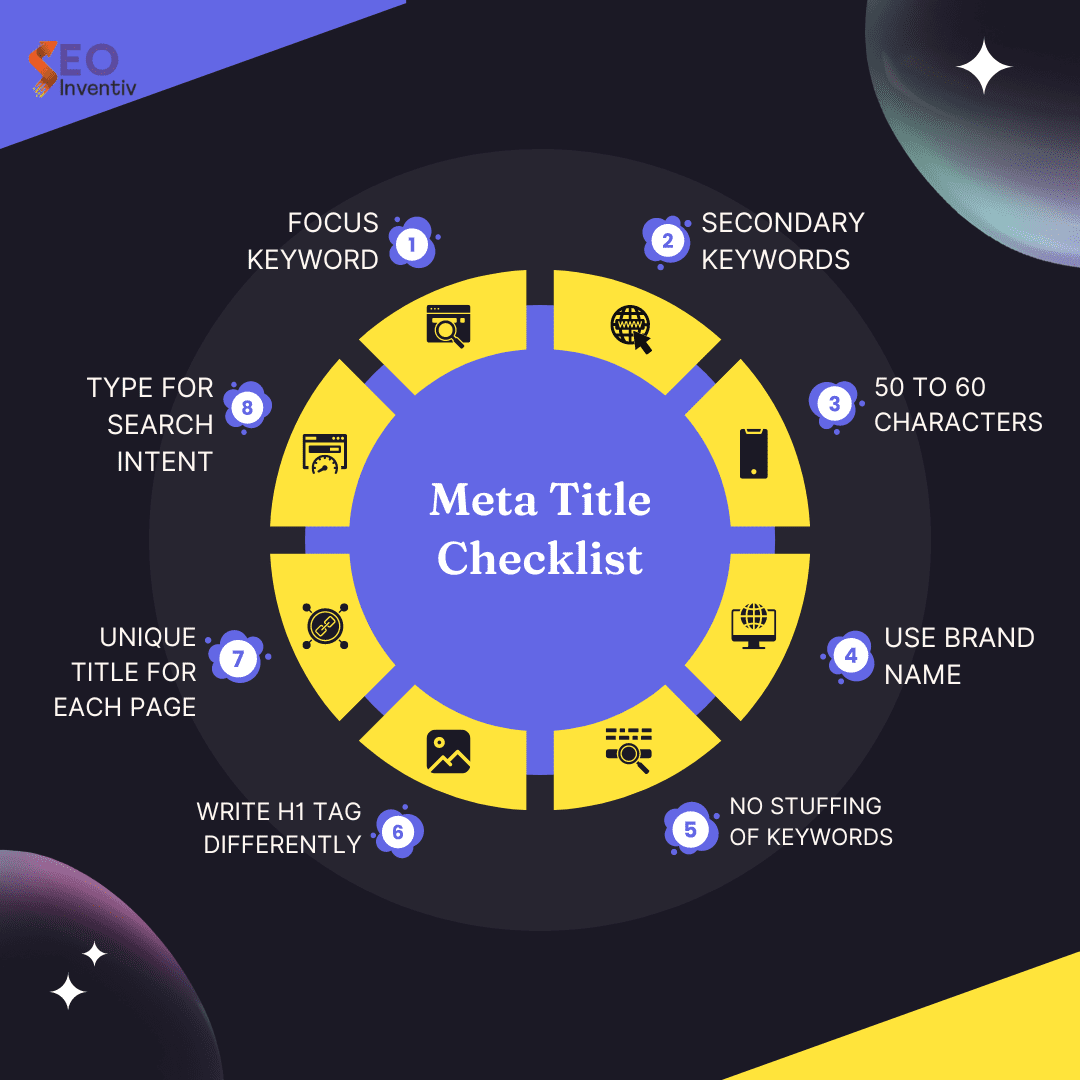
1. Place your focus keyword near the beginning
Place your primary keyword close to the beginning of the title whenever it fits naturally. Early placement helps search engines understand relevance and helps users quickly confirm they are in the right place. If it feels forced, do not do it.
2. Use secondary keywords only if they align
Secondary keywords work when they share the same intent as the primary keyword. For example, a title targeting “SEO copywriting” can naturally include “how to write SEO copy” if both reflect what the page actually delivers.
3. Write about 50 to 60 characters
Aim for roughly 50 to 60 characters, including spaces. This range prevents truncation and keeps the message clean in search results. It is fine to go slightly shorter or longer if clarity improves.
4. Add your brand name
Including your brand name at the end of the title can improve trust and recognition, especially for service pages. Skip it only when space is tight or the brand is not relevant to the search intent.
5. Do not stuff it with keywords
More keywords do not mean better rankings. Overloaded titles reduce clarity, hurt click-through rates, and signal poor quality. Write for people first. Search engines follow.
6. Do not copy the H1 blindly
Your meta title and H1 can be similar, but they do not need to be identical. Use the title to optimise for clicks and the H1 to optimise for on-page clarity. If they match naturally, that is fine. If not, adjust.
7. Make every meta title unique
Each page should have its own meta title. You can follow a consistent structure across similar pages, but always differentiate using intent, topic, or location where relevant.
8. Write for search intent
The most important rule is intent. Ask yourself one simple question. If you were searching, would you click this title over the others? If the answer is no, rewrite it.
Common Meta Title Mistakes To Avoid?
Your meta title is often the first interaction someone has with your website. If it is unclear, misleading, or poorly written, users scroll past without a second thought.
Most ranking issues tied to meta titles are not advanced SEO problems. They are basic mistakes that quietly kill visibility and click-through rates.
Here are the most common ones to avoid.
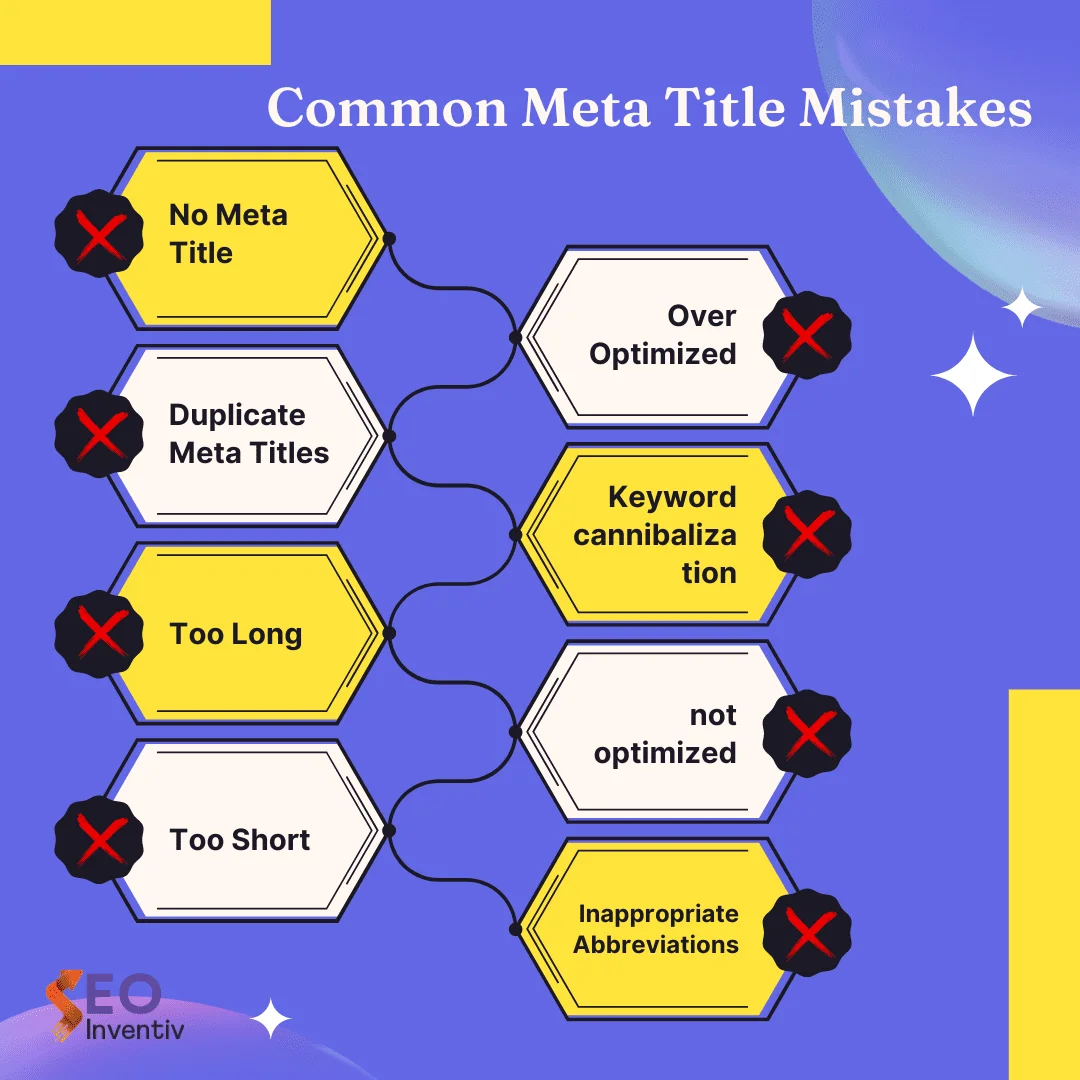
- Missing meta titles altogether: Some pages still do not have meta titles set. When this happens, search engines generate their own version, which is rarely optimized or compelling.
- Duplicate meta titles across pages: Using the same meta title on multiple pages confuses search engines and weakens relevance signals. Each page should clearly communicate its own purpose.
- Titles that are too long: Overly long titles get cut off in search results. When key information is hidden, users lose context and clicks drop.
- Titles that are too short or vague: Very short titles often fail to explain what the page offers. If the title does not clearly state value, users skip it.
- Over-optimised titles: Stuffing keywords into a title does not improve rankings. It reduces clarity and harms user experience, which search engines actively measure.
- Keyword cannibalisation: Using the same primary keyword across multiple pages leads to internal competition. This makes it harder for any one page to rank properly.
- Ignoring local intent: For local businesses, failing to include location context can limit visibility in local search results where intent is high.
- Using unclear abbreviations: Abbreviations that users do not recognize reduce clarity. If users need to guess what a title means, they will not click.
- Titles that offer no real value: If the title does not answer why the page is worth clicking, it will not perform. Titles should set expectations, not just describe a topic.
- Misaligned titles and content: When the title promises something the page does not deliver, search engines may rewrite it and users lose trust.
Why this matters now? Search engines are increasingly rewriting poor titles. Writing clear, relevant, and intent-driven meta titles gives you control over how your page appears and improves your chances of earning the click.
What is a meta description in SEO?
A meta description is a short piece of text that describes what a page is about. It usually appears below the page title and URL in Google search results.
Unlike meta titles, meta descriptions do not directly influence rankings. But they strongly influence whether someone clicks your result or ignores it. That makes them a critical visibility and conversion element.
It’s also important to understand that Google does not always display the meta description you write. In many cases, Google rewrites it based on the user’s search query and the page content. Still, a well-written meta description gives you the best chance to control how your page is presented.
How to Craft Meta Descriptions that Convert
A meta description is your chance to earn the click. You are competing with multiple results on the same screen, and users decide in seconds which one feels most relevant.
You do not need clever copy. You need clarity.
Here is what consistently works.
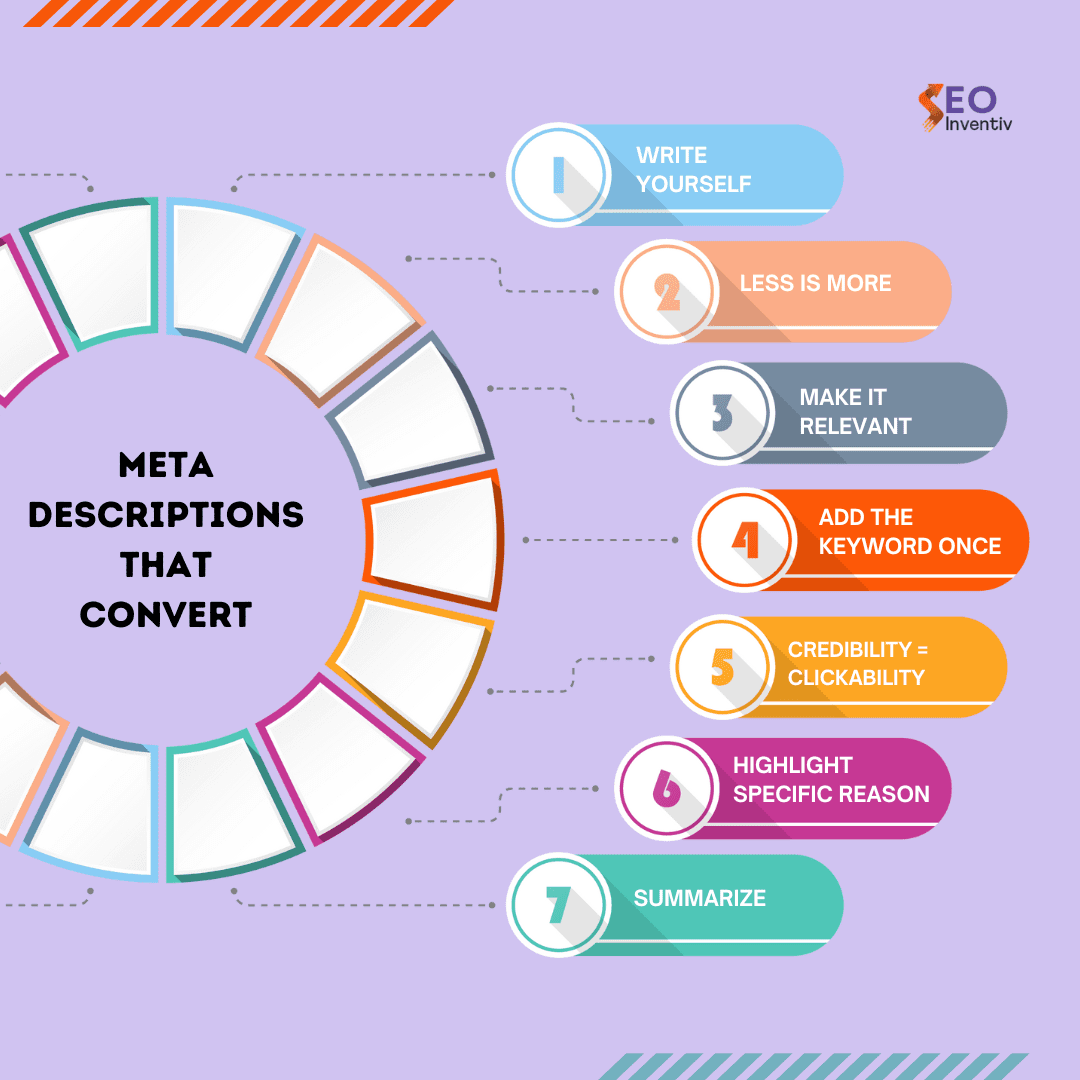
1. Write it yourself
If you do not write a meta description, Google will generate one for you. That snippet is usually pulled from random parts of the page and often lacks context or intent. Writing your own description gives you control over how your page is presented.
2. Keep it concise; don’t exceed 160 characters
Meta descriptions work best when they stay within a readable range, usually around 150 to 160 characters. Longer descriptions risk being truncated, which can cut off important information and reduce clarity.
3. Make it relevant and summarize
Your meta description should accurately summarise what the page delivers. When the description promises something the page does not provide, users leave quickly. That hurts trust and engagement.
4. Use the primary keyword naturally
Including the main keyword once helps reinforce relevance, especially when it matches search intent. This should happen naturally. Forced placement does not improve performance.
5. Credibility creates clickability
People click results they trust. Signals like expertise, clarity, and confidence improve click-through rates more than hype. Avoid exaggerated claims and focus on real value.
6. Highlight a specific reason for reading
A strong meta description answers one simple question. Why should someone choose this result over the others? Be specific about what the reader will gain by clicking.
Why this works today?
Search engines increasingly rewrite weak descriptions. Writing clear, intent-aligned meta descriptions improves your chances of controlling how your page appears and attracting qualified clicks.
What Are The Common Meta Description Mistakes To Avoid?
You can write a great page and still lose clicks if your meta description sends the wrong signals. Most issues with meta descriptions are not technical. They are clarity and intent problems.
Here are the mistakes that show up most often.
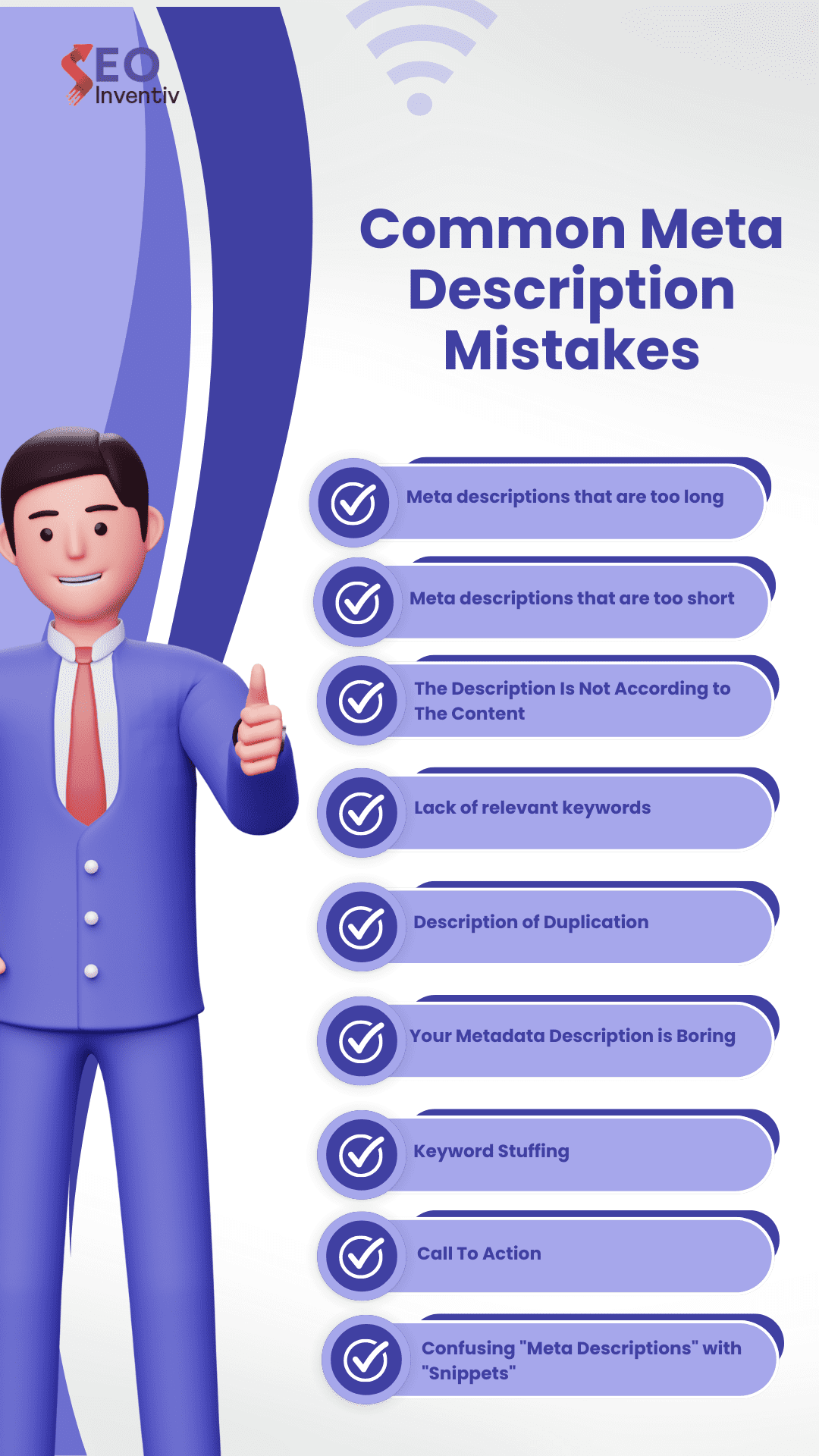
1. Meta descriptions are too long
Meta descriptions that run too long often get cut off, especially on mobile. When key information is truncated, users lose context and skip the result. Keep the message tight and focused.
2. Meta descriptions are too short
Very short descriptions usually fail to explain what the page offers. If you do not use the available space to communicate value, search engines and users treat the page as low priority.
3. The Description does Not correspond to The Content
A meta description should reflect what the page actually delivers. When it promises something different, users bounce quickly and search engines are more likely to rewrite it.
4. Lack of relevant keywords
Meta descriptions help reinforce topical relevance. Skipping key terms makes it harder for users to confirm that your page matches their search intent.
5. Using duplicate descriptions
Using the same meta description across multiple pages weakens differentiation. Each page should clearly communicate its own purpose, even if the structure stays consistent.
6. Keyword stuffing
Repeating keywords does not improve performance. It reduces readability and trust. One natural mention of the primary keyword is enough.
7. Your Meta Description is Boring
Meta descriptions serve two roles. They describe the page and persuade the user. If the description feels flat or vague, it will not earn the click.
8. Skipping a clear call-to-action
A simple call to action helps users understand what they will gain. This does not need to be sales-focused. Even phrases like learn more or understand how can improve clarity.
9. Confusing “Meta Descriptions” with “Snippets”
The meta description you write is not always the snippet Google displays. Search engines often generate snippets dynamically based on the query. Still, writing a strong meta description increases your chances of controlling how your page appears.
Why this matters?
Search engines rewrite weak descriptions more often than strong ones. Clear, intent-aligned meta descriptions give you better visibility and more consistent click-through rates.
Meta Descriptions Checklist
A good meta description does not try to sell everything. It helps the right user understand what the page offers and decide whether to click.
Use this checklist to keep your descriptions clear, relevant, and effective.
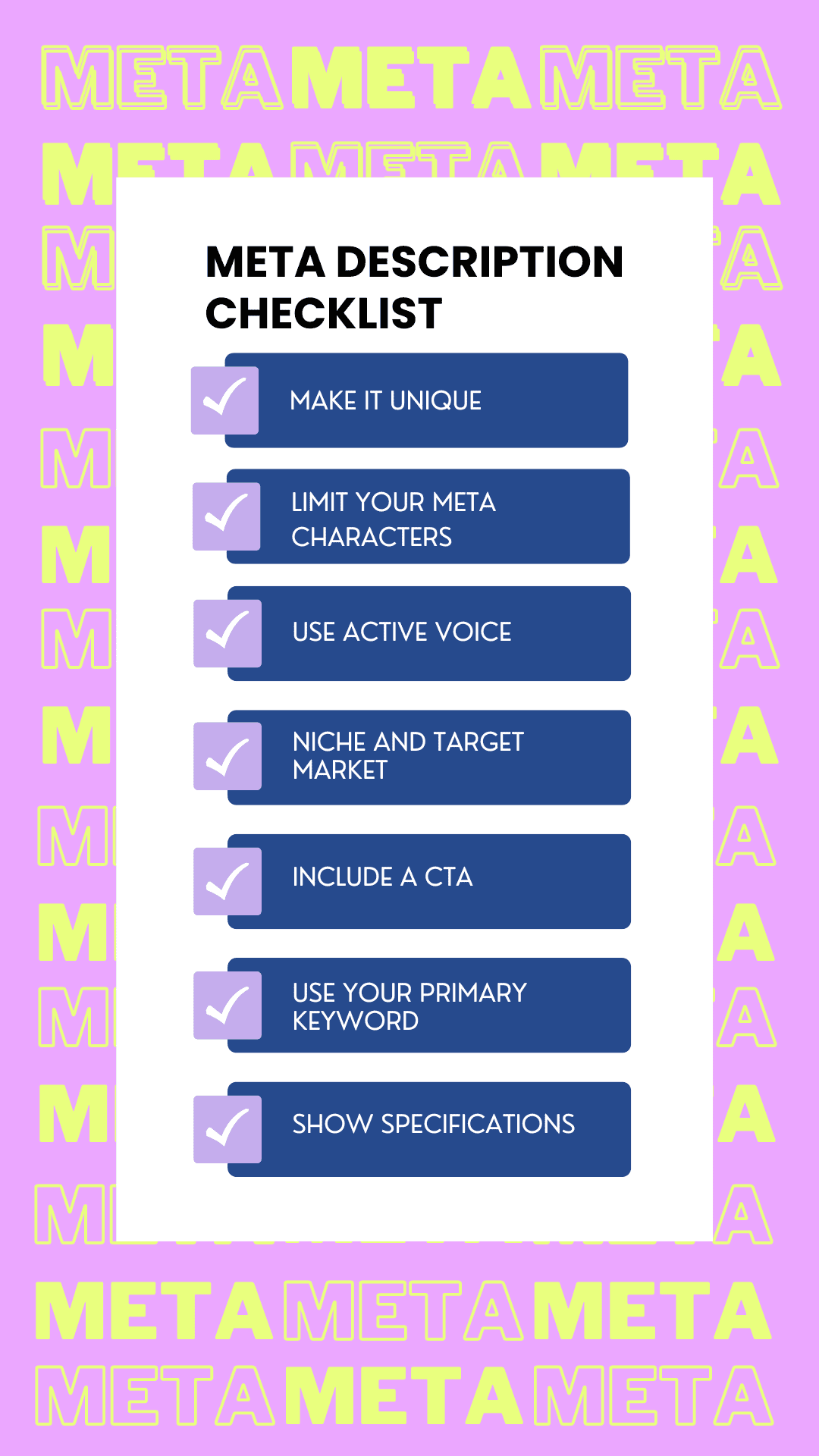
1. Limit your meta characters
Aim for around 150 to 160 characters. Shorter descriptions may lack context, while longer ones risk being cut off. Remember, Google may rewrite your description depending on the query, so clarity matters more than exact length.
2. Use active voice in your meta description
Meta descriptions should be easy to read and sound human. Avoid technical language or vague phrases. Think about what someone is searching for and explain it in simple terms.
3. Include a clear CTA
A light call to action helps users understand what they will gain by clicking. This does not need to be aggressive or sales-driven. Even a simple cue like learn, explore, or understand can improve clarity.
4. Use your primary keyword naturally
Including your main keyword once helps reinforce relevance, especially when it aligns with search intent. Forced placement does not help and often gets rewritten by search engines.
5. Highlight a real differentiator
If your page offers something specific, such as a feature, benefit, or outcome, mention it. This helps users quickly understand why your result is worth choosing over others.
6. Keep every description unique
Each page should have its own meta description. Reusing the same description across multiple pages reduces clarity and weakens visibility. Even similar pages deserve tailored descriptions.
Why this checklist works?
Search engines favour descriptions that are clear, relevant, and aligned with user intent. When your meta description matches what the page delivers, you improve both click-through rates and long-term performance.
Case Snapshot: Improving Search visibility for a Local Waste Management Business
The Problem
A local waste management business in Qatar was facing low and inconsistent search visibility. Multiple pages were ranking for the same keywords, page intent was unclear, and titles and meta descriptions were poorly aligned. Despite offering essential services, the website struggled to attract qualified traffic and convert search visibility into leads.
What We Did
We began by analysing Google Search Console data to identify keyword cannibalisation, intent overlap, and ranking inconsistencies across service pages.
Using these insights, we rebuilt the website’s keyword architecture so that each core service had a single, clearly defined page. Internal linking was restructured to support this hierarchy, and meta titles, meta descriptions, and headings were optimised across the site to reinforce clear intent.
The focus was simple and deliberate. One service, one page, one clear search signal.
The Result
Within three months, performance improved steadily.
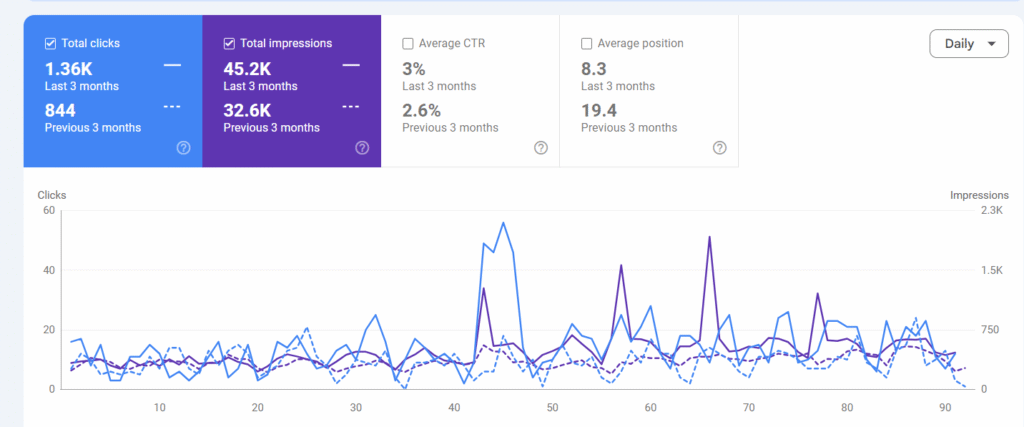
- Total clicks increased from 844 to 1.36K
- Total impressions grew from 32.6K to 45.2K
- Average CTR improved to 3%
- Average position improved from 19.4 to 8.3
- In addition to traditional search gains, the website began appearing in AI-powered search experiences for 30+ relevant keywords, driven by clearer metadata, stronger structure, and improved content alignment.
Key Takeaway
For local service businesses, clean keyword mapping and well-written meta titles and descriptions are foundational. When supported by strong internal linking and intent clarity, they directly impact visibility, trust, and lead generation.
Strong rankings are rarely the result of one tactic. They come from clarity across the site. Clear intent, clean structure, and metadata that accurately represents what each page delivers.
In this case, the results were driven by fixing fundamentals. Keyword alignment, internal linking, and well-written meta titles and descriptions worked together to stabilise rankings, improve visibility, and increase qualified traffic. When SEO decisions are backed by data and user intent, results follow naturally.
Meta titles and meta descriptions may seem small, but they play a critical role in how your website is interpreted and chosen in search results. Treat them with intent. When done right, they support long-term visibility, engagement, and conversions.
Work With Us
If you want a structured, data-led SEO approach that focuses on visibility and conversions, our Fully Managed SEO Services are built to support that.
Start with a free SEO consultation and get clarity on what your website needs to improve rankings and performance.