WhatsApp Now
 +(91) 8700778618

TLDR: SERP features are the special results that appear on Google’s search engine results page beyond the standard ten blue links. They include featured snippets, knowledge panels, image packs, local packs, and more than a dozen other formats that can either steal clicks from your website or dramatically amplify your organic visibility. Knowing which features exist, how they work, and how to optimize for them is one of the highest-leverage SEO skills available to any website owner or digital marketer in 2026.
 Picture the last time you searched for something on Google and got your answer without clicking on a single result. Maybe you asked how long to boil an egg and a box at the top of the page told you exactly what you needed. Maybe you searched for a local restaurant and a map with ratings appeared before any traditional links. Maybe you typed in a celebrity’s name and an entire sidebar appeared with their biography, age, and filmography without you visiting a single website.
All of those experiences were SERP features, and they represent one of the most significant shifts in how search engines work and how organic traffic flows across the internet. In the early days of Google, search results were simple. Ten blue links on a white background. The first result got the most clicks, the second got fewer, and by page two, nobody was looking anymore. That simplicity is gone. Modern search results pages are dynamic, visual, and packed with elements designed to answer questions directly, often before a user ever reaches an organic result.
For website owners, this creates a paradox. Google is simultaneously the most powerful source of organic traffic available and a platform that is actively working to answer questions without sending users anywhere. Understanding SERP features is how you navigate that paradox, either by capturing the features that amplify your visibility or by building a traffic strategy that accounts for the ones that suppress it.

What Exactly Is a SERP Feature
A SERP feature is any result on a Google search results page that is not a standard organic blue link result. Standard organic results show a title, a URL, and a meta description. Everything else, the boxes, the maps, the images, the carousels, the panels, the snippets, the questions, the videos, is a SERP feature.
Google’s search results page in 2026 is rarely a simple list. For most queries, the page includes a mix of several different result types, each designed to serve a specific kind of search intent. Some features appear because of the type of query, such as a map appearing for a local business search. Some appear because of how content is structured on a particular website. Some appear because Google’s AI has determined that a certain format best serves what the user is actually trying to accomplish.
The important thing to understand is that SERP features are not random. They follow patterns that can be researched, understood, and optimized for. The websites that consistently appear in featured snippets, knowledge panels, and other prominent SERP positions have not gotten there by accident.
The Most Important SERP Features in 2026 and How They Work
Featured Snippets
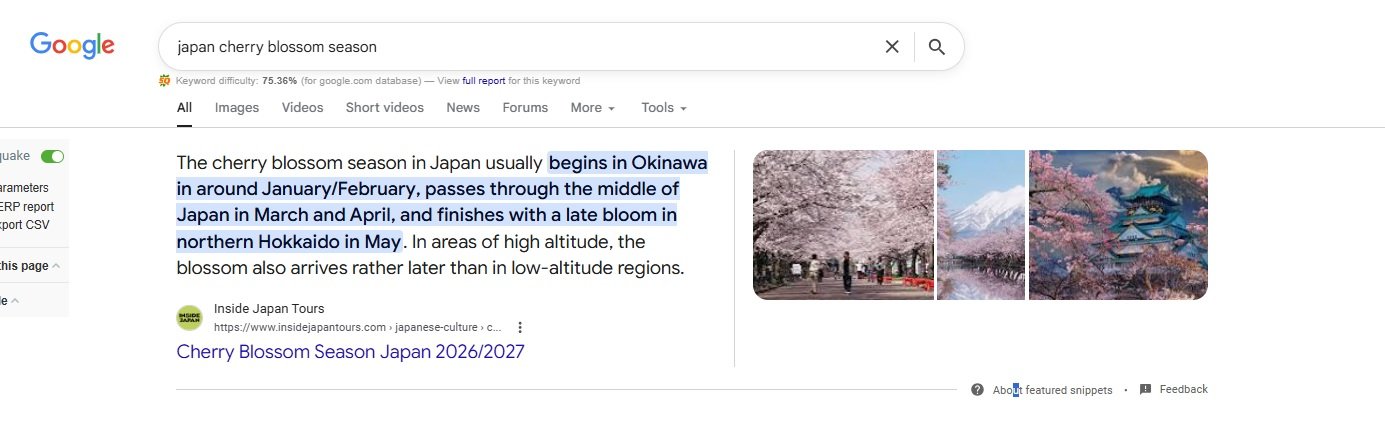
Featured snippets are the single most discussed and most contested SERP feature in SEO. They appear at the very top of the search results, above all organic links, in a box that typically contains a direct answer to a question query, an extract from a web page, and the source URL.
Featured snippets appear in four main formats. Paragraph snippets answer who, what, why, and how questions with a short block of text. List snippets present step-by-step processes or ranked items in ordered or unordered list format. Table snippets display comparative data in a structured table format. Video snippets pull a specific timestamp from a YouTube video that answers the query.
Appearing in a featured snippet for a high-volume query can produce a dramatic increase in organic traffic. The featured snippet position is sometimes called position zero because it appears before the first organic result, and it carries a level of implied authority that traditional first-position results do not match.
Optimizing for featured snippets requires writing content in a format that directly answers specific questions, using clear heading structures that signal topic organization to Google, keeping direct answers concise at forty to sixty words, and structuring lists and tables in clean HTML that Google can easily extract and display.
Knowledge Panels
Knowledge panels appear on the right side of search results for entities that Google has sufficient structured data to create an information summary about. They appear for people, organizations, places, movies, books, products, and other well-defined entities.
For an individual who appears in a knowledge panel, the box typically shows their photo, a brief description, key facts such as birth date and profession, links to social profiles, and related entities. For a business, the knowledge panel might show location, hours, contact information, website, and customer reviews.
Knowledge panels are largely driven by structured data markup on websites, Wikipedia entries, and Google’s own entity recognition systems. Getting a knowledge panel for a person or organization involves building a sufficient footprint of consistent, authoritative information across structured data sources that Google trusts.
 Local Pack
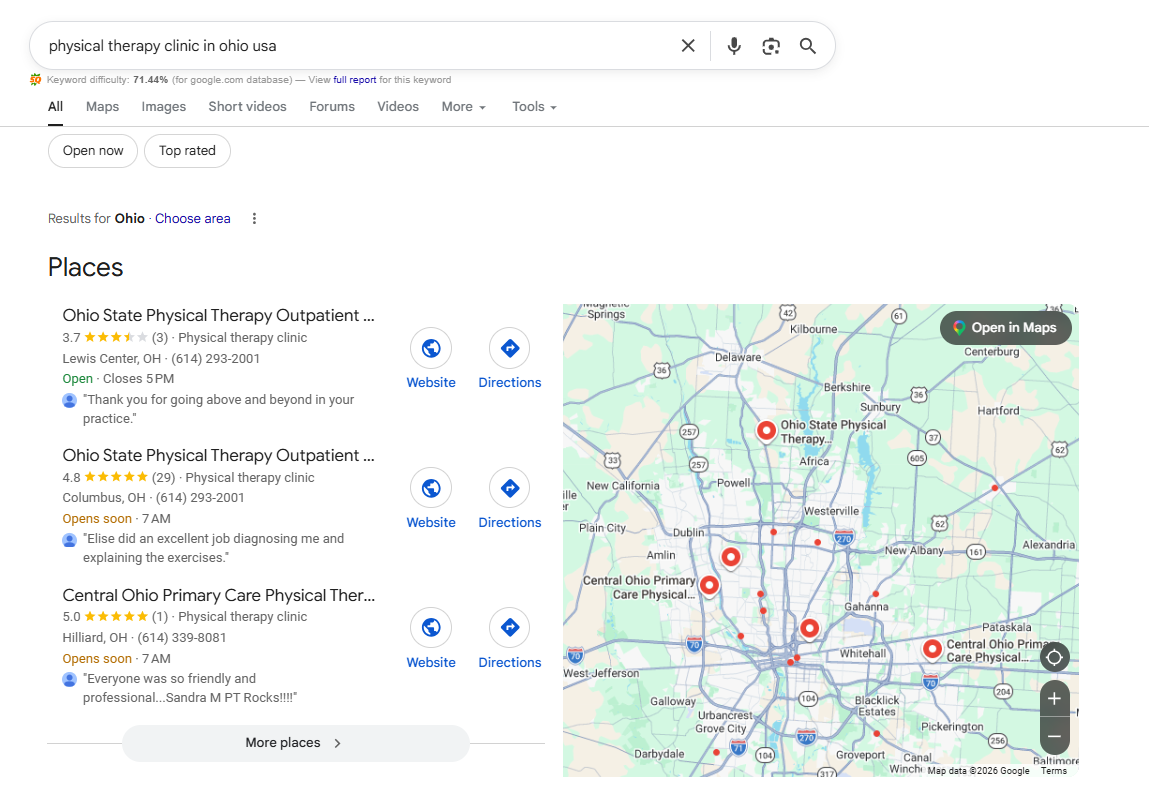
The local pack is the map and three-listing format that appears for queries with local intent, typically searches that include a location name or searches where Google infers the user wants a nearby result. A search for coffee shop, dentist, or plumber in any major city will almost always trigger a local pack at the top of the results page.
The local pack is driven by Google Business Profile data rather than traditional website SEO signals. Businesses that want to appear in the local pack need a fully completed and regularly updated Google Business Profile, consistent name, address, and phone number information across the web, strong review profiles on Google, and location-relevant content on their website.
Local pack visibility is one of the most commercially valuable SERP features available for businesses with physical locations or defined service areas. The three businesses that appear in the local pack for high-intent local queries capture a disproportionate share of local search traffic and customer enquiries.
 People Also Ask
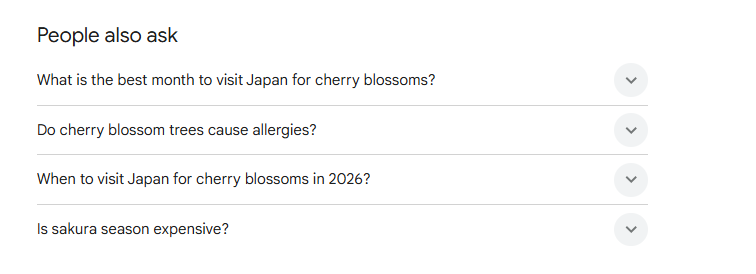
People Also Ask, commonly abbreviated PAA, is one of the most frequently appearing SERP features in 2026. It appears as a box containing a series of expandable questions related to the original search query. When a user clicks on one of the questions, a short answer appears, typically extracted from a web page, along with a link to the source.
What makes PAA particularly interesting from an SEO perspective is its dynamic nature. Clicking on a question in the PAA box generates new related questions, theoretically allowing users to explore a topic indefinitely without leaving the Google results page. This behavior reduces click-through rates to individual websites but creates an opportunity for websites whose content consistently provides the best answer to the questions users are exploring.
Appearing in PAA boxes requires the same approach as featured snippet optimization: structured content that directly answers specific questions in clear, concise language. Websites that organize their content around answering questions in a logical progression frequently appear across multiple PAA boxes for related queries.
Image Pack
Image packs appear as a horizontal row of images within the standard search results, typically for queries where visual information is relevant. Clicking on an image in the pack takes the user to Google Images rather than directly to the source website.
Image pack optimization involves using descriptive, keyword-relevant file names for images, writing detailed and accurate alt text, surrounding images with relevant textual content, and ensuring images are compressed for fast loading. Structured data markup for images can also improve the chances of appearing in image packs for relevant queries.
Video Carousel
Video carousels appear for queries where Google determines that video content best serves the user’s intent. They display a horizontal scrollable row of video thumbnails, typically from YouTube, with titles and channel names. For how-to queries, tutorial content, and entertainment-related searches, video carousels frequently appear above traditional organic results.
Optimizing for video carousels requires publishing video content on YouTube with highly descriptive titles, detailed descriptions that include relevant keywords, accurate transcripts, and structured data markup. Timestamps that organize video content into labeled chapters help Google identify which portion of a video answers specific queries.
Shopping Results
Shopping results appear as a grid of product images with prices, retailer names, and ratings for commercial product queries. They are technically paid placements through Google Shopping campaigns, but they occupy premium SERP real estate and are relevant for any e-commerce business competing in product search categories.
Sitelinks
Sitelinks appear below the main result for well-established websites, displaying additional links to specific pages within the site. They typically appear for branded queries where the user is clearly looking for a specific website. Google generates sitelinks automatically based on site structure and user behavior data, but a well-organized site architecture improves the likelihood of sitelinks appearing.
Reviews and Ratings
Star rating displays appear in organic results for websites that implement review structured data markup. For product pages, recipe sites, local business listings, and software review pages, displaying star ratings in the organic result can significantly improve click-through rates by adding social proof to the result before the user reaches the website.
AI Overviews
AI Overviews, introduced by Google in 2024 and significantly expanded in 2025 and 2026, represent the newest and most disruptive SERP feature category. They appear at the very top of results for a growing range of queries and provide an AI-generated answer synthesized from multiple web sources, with citation links to the sources used.
AI Overviews present both a challenge and an opportunity for content creators. They reduce clicks for queries where the AI answer is comprehensive enough to satisfy the user’s need. But they also create a new form of brand visibility through citation, where being cited as a source in an AI Overview exposes the website to users who might not have clicked on a traditional organic result.
Optimizing for AI Overview citation involves the same foundational practices as featured snippet optimization: clear, direct, factually accurate content written in response to specific questions, strong E-E-A-T signals including demonstrated expertise and authoritative backlinks, and structured content that AI systems can easily parse and extract accurate information from.
How SERP Features Affect Click-Through Rates
The relationship between SERP features and click-through rates is complex and varies significantly by feature type and query category.
Featured snippets show a nuanced pattern. For simple factual queries where the snippet fully answers the question, click-through rates to the source website can actually be lower than for the same position without a snippet because users get what they need from the snippet alone. For more complex queries where the snippet serves as a preview that increases curiosity, click-through rates can be higher than for equivalent positions without snippets.
Local packs consistently show high click-through rates and strong conversion intent because they serve users who are actively looking for a local solution, meaning the traffic that reaches local pack results is typically more purchase-ready than general organic traffic.
People Also Ask results show lower individual click-through rates but high impression volumes, making them valuable for brand awareness even when they do not drive significant direct traffic.
AI Overviews show the most complex click-through pattern of any current SERP feature, with significant variation based on query type, user intent, and how fully the AI answer addresses the search query.
How to Find Out Which SERP Features You Already Rank For
Tools like Semrush, Ahrefs, and Moz all provide SERP feature tracking as part of their keyword research and rank tracking functionality. Within these tools, you can see which of your keywords trigger SERP features, which features you currently appear in, and which features competitors are capturing that you are not.
This analysis typically reveals three categories of opportunity. Keywords where you rank in traditional organic results and could capture the additional SERP feature with content optimization. Keywords where a competitor holds the SERP feature and is gaining visibility above your organic position. And keywords where the SERP feature is suppressing click-through rates enough to question whether the ranking is as valuable as it appears.
Practical Steps to Optimize for SERP Features
Getting your content into SERP features requires a combination of technical implementation and content strategy decisions. Here is a straightforward process for approaching SERP feature optimization systematically.
Start by auditing your existing keyword rankings for SERP feature presence using a tracking tool. Identify the keywords where you rank on page one but do not hold the relevant SERP feature. These are your highest-priority optimization targets because you already have the foundational authority needed to compete for the feature.
For featured snippet targets, rewrite relevant sections of your content to directly answer the query in the first one to two sentences following a clear question-format heading. Keep the direct answer between forty and sixty words, then follow with expanded explanation that serves readers who want more depth.
Implement structured data markup across your site for the content types that generate rich results. Review markup for review-based content, FAQ markup for question and answer sections, HowTo markup for instructional content, and Article markup for editorial content all create the technical signals that Google uses to identify content eligible for rich result formats.
Build your Google Business Profile comprehensively if local SERP features are relevant to your business. Complete every available field, publish regular posts, actively collect and respond to reviews, and ensure your business information is consistent across all online directories and citation sources.
Optimize your images systematically with descriptive file names, accurate alt text, and surrounding contextual content. Compress images for fast loading and implement image structured data for product and recipe images where applicable.
Why Working With SEO Professionals Accelerates SERP Feature Gains
SERP feature optimization is one of the areas of SEO where professional expertise produces the clearest return on investment. The technical implementation of structured data markup, the content strategy decisions around featured snippet targeting, and the ongoing monitoring of feature gains and losses all require a level of sustained attention and specialized knowledge that most business owners and content creators do not have the bandwidth to develop while also running their core operations.
Working with professionals who offer affordable SEO services packages from specialists like SEOInventiv gives businesses access to structured data implementation, content optimization for featured snippets, and SERP feature tracking without building an in-house SEO team. For smaller businesses and growing websites that want to compete for valuable SERP features without the overhead of full-time SEO staff, this kind of packaged service delivers professional-grade optimization at accessible price points.
For businesses that want to discuss their specific SERP feature opportunities before committing to a service, starting with a free SEO consultation allows an expert assessment of which features your current rankings put you in position to capture and what technical or content changes would produce the fastest gains.
The Connection Between SERP Features and Long-Term SEO Strategy
SERP feature optimization does not exist in isolation from broader SEO strategy. The content quality signals that make a page eligible for a featured snippet are the same signals that drive strong organic rankings in traditional results. The structured data implementation that enables rich results also improves how Google understands and categorizes the overall site. The local authority signals that drive local pack appearances also contribute to domain-level trust signals that benefit all organic rankings.
This integration means that SERP feature optimization is not a separate tactic to be pursued independently of general SEO work. It is a refinement layer that sits on top of strong foundational SEO practice, producing additional visibility gains for websites that have already built the authority and content quality that competitive organic performance requires.
For businesses that want this integrated approach handled comprehensively, fully managed SEO services from SEOInventiv cover the full spectrum from foundational technical SEO and content strategy through to SERP feature optimization and AI Overview citation building, treating all of these elements as parts of a coherent organic visibility strategy rather than separate tactics competing for budget and attention.
SERP Feature Quick Reference
| Feature | Trigger Type | Optimization Approach | Click Impact |
|---|---|---|---|
| Featured Snippet | Question queries | Direct answer formatting, 40-60 words | High positive |
| Knowledge Panel | Entity searches | Structured data, Wikipedia, consistent NAP | Brand visibility |
| Local Pack | Local intent queries | Google Business Profile, reviews | Very high positive |
| People Also Ask | Most queries | Question-based content structure | Medium |
| Image Pack | Visual queries | Alt text, file names, context | Medium |
| Video Carousel | How-to, tutorials | YouTube optimization, timestamps | High for video |
| Shopping Results | Product queries | Google Shopping, product markup | High commercial |
| AI Overviews | Informational queries | E-E-A-T, direct answers, citations | Complex |
| Sitelinks | Branded queries | Site architecture, internal linking | Positive |
| Review Stars | Product, local | Review structured data markup | CTR improvement |
FAQs
What is the difference between a SERP feature and a paid search result? Paid search results, labeled as sponsored, are purchased through Google Ads and appear based on bidding and quality score systems. SERP features like featured snippets, knowledge panels, and People Also Ask are organic placements that Google assigns based on content quality, structured data, and relevance signals. Shopping results are a partial exception as they can be both paid placements through Google Shopping campaigns and organic product listings.
Can small websites compete for featured snippets against large established sites? Yes. Featured snippets are awarded based on how well a specific piece of content answers a specific query, not on overall domain authority. Small websites regularly capture featured snippets for niche queries by writing more direct, clearly structured answers than larger competitors whose content is less precisely targeted. The most accessible featured snippet opportunities are typically long-tail question queries in specific niches where large sites have not invested in direct answer formatting.
How quickly can SERP feature optimization produce results? Featured snippet gains can appear within days to weeks of content optimization for pages that already rank on page one for the relevant query. Structured data implementation for rich results typically shows in Google Search Console within two to four weeks of implementation. Local pack improvements respond to Google Business Profile optimization within weeks. AI Overview citation is less predictable and may take longer as Google’s AI systems update their source assessments on longer cycles.
Do SERP features always increase website traffic? Not always. Some SERP features, particularly simple featured snippets and AI Overviews that fully answer a query, can reduce individual page click-through rates by satisfying user intent before a click is needed. The strategic question is whether the brand visibility from appearing in these features has value beyond the immediate click, which for most businesses it does, and whether the query types being targeted are ones where reduced click-through rates represent a meaningful business problem.
What structured data types are most important to implement for SERP features? The highest-priority structured data types for most websites are FAQ schema for question and answer content, Article schema for editorial and blog content, LocalBusiness schema for businesses with physical locations, Product schema for e-commerce pages, Review schema for pages with customer ratings, and HowTo schema for instructional content. Each of these enables specific rich result types that improve SERP visibility beyond standard organic results.
Is it possible to appear in multiple SERP features for the same query? Yes. A single website can simultaneously appear in a featured snippet, the organic results, a People Also Ask box, and an image pack for the same or related queries. This kind of dominant SERP presence is the goal of comprehensive SERP feature optimization and represents the maximum organic visibility a website can achieve for a given search topic.
How do AI Overviews affect the value of traditional SEO in 2026? AI Overviews have changed the click-through dynamic for informational queries but have not eliminated the value of traditional SEO. Websites that appear as citations in AI Overviews gain brand exposure to users who may not click immediately but develop familiarity with the brand over repeated exposures. Additionally, AI Overviews do not appear for all query types, leaving significant categories of commercial, navigational, and complex informational queries where traditional organic rankings continue to drive substantial click-through traffic. The websites cited most frequently in AI Overviews are those with the strongest E-E-A-T signals, meaning that the foundational work of traditional SEO remains the best path to AI Overview visibility as well.