
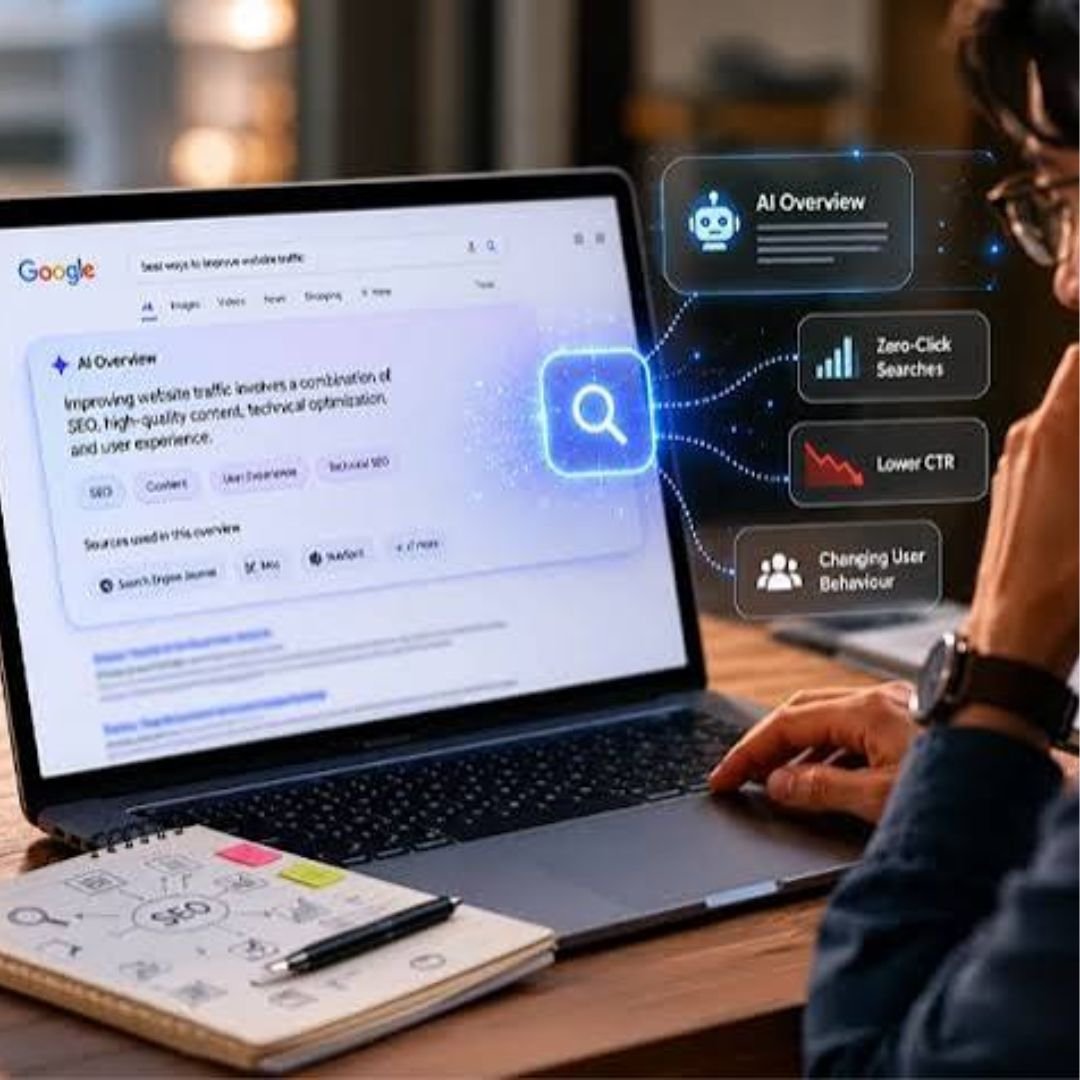
 The AI search revolution is here. ChatGPT now serves over 1 billion daily queries, and AI-referred sessions jumped 527% in early 2025. Yet here’s the paradox that’s keeping marketers up at night: when Google AI Overviews appear, click-through rates drop from 15% to 8%—a 47% reduction.
Your content can rank #1 on Google and still be invisible to the 60% of searchers who never click past the AI answer. That’s not a bug in the system—it’s the new reality of how people find information.
Generative Engine Optimization (GEO) is the discipline of structuring your content so AI platforms—ChatGPT, Perplexity, Gemini, Claude, and Google AI Overviews—cite your brand as a trusted source. A landmark Princeton study proved that GEO-optimized content can boost visibility by up to 40%. This isn’t speculation. It’s a proven framework for owning the new search paradigm.
At SEO Inventiv, we’ve built our entire AI SEO framework around this shift. We combine entity optimization, content architecture, and authority-building backlinks to help brands get cited in AI answers—not just rank in blue links.
In this guide, you’ll learn:
Why each AI platform cites brands differently (and why a one-size-fits-all strategy fails)
The 11 essential GEO tools that top marketers are using right now
How to build entity-first content that AI engines actually trust
A step-by-step execution framework you can implement this week
Let’s dive in.
TL;DR
GEO is the new SEO. AI search engines now handle 12–18% of English-language informational queries. AI-referred traffic converts at 4–5x the rate of organic search, yet brands are optimizing for a click-based model that’s rapidly becoming obsolete.
The Princeton study proves GEO boosts visibility by up to 40%. But success requires a multi-LLM strategy: ChatGPT rewards authority and consensus; Perplexity prioritizes freshness and semantic depth; Gemini aligns with E-E-A-T; and Claude favors neutrality and verifiable citations.
The winning formula: Entity-first content clusters + answer-first formatting + platform-specific optimization + transparent reporting. SEO Inventiv’s framework delivers this with structured, AI-powered systems that scale.
 Why GEO Is the Most Important Shift in Search Since Google
Let’s start with the numbers that matter.
AI search traffic converts at 14.2% compared to Google’s 2.8%.
That’s not a marginal improvement. That’s a 5x increase in conversion rate from the same buyer intent. When someone asks an AI platform a question, they’re already in research mode—and if your brand is cited in the answer, you’ve won their trust without a single click.
Here’s what else is happening:
Zero-click search has reached 60% of all Google queries. People get their answer and leave. If your brand isn’t mentioned in that AI Overview, you never had a chance.
AI search engines sent 1.13 billion referral visits to websites in June 2025 alone—a 357% year-over-year increase. ChatGPT accounted for 78% of that traffic.
Only 38% of pages cited in AI Overviews also rank in the top 10 organic results. That means 62% of AI citations come from outside the traditional top 10. Your organic rank and your AI presence are correlated, but they’re not the same thing.
The GEO services market is projected to grow from $1.1 billion in 2025 to over $16 billion by 2032—a 42% CAGR. This isn’t a trend. It’s a fundamental restructuring of how information is discovered and consumed.
 The Multi-LLM Reality: Why ChatGPT, Perplexity, Gemini, and Claude Are Not the Same
Here’s the mistake most brands make: they optimize for one platform and assume it works everywhere.
It doesn’t.
A 2026 study analyzing 34,234 AI responses found that ChatGPT cited brands in just 0.59% of answers, while Perplexity cited brands in 13.05%. That’s a roughly 46x difference for the same category of query.
Claude gave brands the highest owned-citation share at 9.1%, while ChatGPT was consistently the lowest across every brand tested.
Each platform has its own ranking logic:
| Platform | Core Philosophy | What It Rewards |
|---|---|---|
| ChatGPT | Consensus & Authority | Entity recognition, mentions on authoritative lists, strong backlinks |
| Perplexity | Real-Time & Semantic Depth | Content freshness, L3 reranker compliance, comprehensive topic coverage |
| Gemini | Helpfulness & Trust | E-E-A-T signals, conversational alignment, Knowledge Graph integration |
| Claude | Safety & Neutrality | Constitutional compliance, transparency, verifiable citations |
The implication is clear: if you’re optimizing for only one platform, you’re invisible on the others.
Here’s how we address this at SEO Inventiv: our AI SEO framework builds a unified content foundation (entity-first, structured, authoritative) and then tailors for each platform’s unique signals. This isn’t extra work—it’s working smarter.
 The 11 Best GEO Tools Every SEO Must Know in 2026
You can’t optimize what you can’t measure. Here are the essential tools for building and tracking your GEO strategy.

1. Also Asked
What it does: Discovers related user questions in real time so you can cover key topics that generative engines prefer.
Why it matters: AI engines reward content that answers the full range of user questions, not just the surface-level query. Also Asked gives you the exact questions real people are asking.
How to use it: Enter your primary keyword and the tool generates a visual map of related questions. Use these to build comprehensive FAQ sections, create topic clusters, and ensure your content addresses every angle of a query.

2. Geopite GEO Audit (Free)
What it does: Quickly scans your website for GEO compliance, flagging issues that prevent your brand from ranking in generative AI search results.
Why it matters: Most sites have hidden technical barriers that block AI crawlers. This tool surfaces them instantly, giving you a clear starting point for optimization.
How to use it: Enter your website URL and the tool generates a report of GEO readiness issues. Prioritize fixes based on severity and start implementing them immediately.
3. Copy.ai
What it does: Creates compelling, SEO-ready content snippets and blog posts, optimized for both people and AI discovery.
Why it matters: Speed matters in GEO—the faster you can publish high-quality, optimized content, the faster you build citation equity. Copy.ai accelerates your content production without sacrificing quality.
How to use it: Use the platform’s templates to generate blog introductions, social media posts, and content outlines. Always review and personalize the output to maintain your brand voice.
4. Semrush AI Visibility
What it does: Offers advanced AI-powered research and keyword analysis so your content gets noticed and cited by generative engines.
Why it matters: Semrush’s data infrastructure helps you identify the topics and entities that AI engines are actively seeking, ensuring you’re investing effort in the right areas.
How to use it: Use the AI Visibility feature to track your brand’s presence across AI platforms. Monitor competitor performance and identify content gaps that you can exploit.

5. Otterly AI
What it does: Monitors your brand’s presence in AI-powered search, tracking mentions and sentiment to inform your GEO strategy.
Why it matters: You need to know if you’re being cited. Otterly gives you that visibility across multiple AI platforms.
How to use it: Set up tracking for your brand name, products, and key executives. Review the dashboard regularly to see when and where you’re mentioned, and adjust your strategy accordingly.

6. InLinks
What it does: Automatically identifies and links entities in your content, ensuring AI engines understand your topics and boost your search presence.
Why it matters: Entity recognition is a core signal for ChatGPT, Gemini, and Claude. InLinks operationalizes entity SEO at scale.
How to use it: Install the InLinks script on your site or use their content editor. The tool will automatically suggest entity links and schema markup. Review and approve the suggestions to build a strong entity network.

7. Writesonic (Free credits available)
What it does: Generates optimized blog posts, social media content, and more, with 25 free credits every month.
Why it matters: Content production at scale is essential for GEO—you need to cover topics comprehensively, not just publish isolated posts.
How to use it: Use the AI article writer to generate long-form content. Then use the tool’s SEO optimization features to ensure your content includes the right entities, keywords, and structure.
8. HubSpot’s AI Search Grader (Free)
What it does: Evaluates your site’s performance in AI search results and offers actionable improvement tips.
Why it matters: Free, easy-to-use, and provides a baseline for your GEO performance. Perfect for getting started without financial commitment.
How to use it: Enter your domain and the tool generates a graded report with specific recommendations. Implement the highest-impact fixes first.

9. Nightwatch Research Tool (Free)
What it does: Tracks your keyword rankings with real-time dashboards, giving you actionable data for GEO success.
Why it matters: You need to know where you stand before you can improve. Nightwatch provides clear, visual dashboards that make tracking progress simple.
How to use it: Add your target keywords and track them across search engines. Use the data to identify which pages are performing well and which need optimization.
10. Geopite GEO Content Checker (Free)
What it does: Checks individual pages for GEO signals, helping you tweak content for maximum visibility in generative AI rankings.
Why it matters: Page-level optimization is where most GEO wins happen. This tool gives you specific, actionable fixes for each piece of content.
How to use it: Enter the URL of a specific page. Review the GEO signal report and implement the suggested improvements. Re-check after making changes to verify improvement.
11. Frase.io
What it does: Helps you research, write, and optimize content for both search engines and AI platforms by analyzing top-ranking pages and identifying key topics.
Why it matters: Frase’s content briefs ensure you cover all relevant subtopics and entities, making your content more comprehensive and AI-friendly.
How to use it: Enter your target keyword, and Frase generates a content brief with recommended sections, questions to answer, and entities to include. Use this as your content outline.
 How to Build Content That AI Engines Actually Cite
The Princeton study that formalized GEO identified three techniques that consistently boost visibility:
Cite credible sources within your content
Add relevant statistics to support your claims
Include expert quotations to demonstrate authority
But that’s just the starting point. Here’s the full framework for building AI-citable content.
Step 1: Adopt an Entity-First Strategy
Traditional SEO optimizes for keywords. GEO optimizes for entities—people, places, products, organizations, and concepts that AI engines understand through relationships, not just terms.
Why entity-first works: Content that defines 15 or more connected entities is cited 4.8 times more frequently by AI engines. And the right entity structure leads to 73% more AI selections.
How to implement:
Define your canonical entities—the core topics your brand owns
Build topic clusters around each entity (hub-and-spoke model)
Use consistent terminology across all content
Implement schema markup (FAQPage, HowTo, Organization, Article)
Link internally with entity-rich anchor text
Step 2: Write Answer-First Content
AI models are optimized to find the clearest answer to a query. If your introduction spends three paragraphs setting context before getting to the point, an AI will skip past it or find a cleaner source.
Structure your content so the answer comes first:
Lead with the key point, not with setup
Use descriptive H2 and H3 headings that mirror real queries
Write in short sentences and use bullet points for lists
Put definitions and key facts in the first 100 words
Create FAQ sections to capture conversational search queries
Step 3: Build for Each Platform’s Signals
Here’s where the multi-LLM strategy comes to life:
For ChatGPT:
Build authority through backlinks and mentions on authoritative lists
Ensure your brand is recognized as an entity in the Knowledge Graph
Focus on consensus-building content that aligns with established facts
For Perplexity:
Keep content fresh—regular updates matter more here than anywhere else
Cover topics comprehensively and semantically
Cite authoritative domains (.edu, .gov, established news)
For Gemini:
Demonstrate E-E-A-T with author bylines, credentials, and citations
Use conversational language that aligns with natural queries
Implement structured data to feed Google’s Knowledge Graph
For Claude:
Maintain a neutral, fact-based tone (avoid aggressive marketing language)
Cite sources transparently and verifiably
Structure content for easy extraction (Claude’s “Artifacts” feature)
Step 4: Measure and Iterate
The final pillar of any GEO strategy is measurement. You need to track:
AI brand mention rate: How often your brand appears in AI responses
Citation frequency: How often your content is linked or referenced
AI share of voice: Your mentions vs. competitor mentions
AI-driven traffic: Sessions referred from AI platforms
 How SEO Inventiv Delivers GEO Results
At SEO Inventiv, we’ve built our entire AI SEO framework around the principles outlined above. Our clients consistently achieve measurable presence in AI search engine results, with 40–120% organic traffic growth within 6 months.
Here’s how we do it:
1. Clear Picture of Where You Stand
We begin by understanding your business, audience, and competitive landscape. This baseline guides every decision.
2. Identifying What’s Holding You Back
Deep technical, structural, and content-level evaluations reveal gaps in crawlability, relevance, and performance.
3. Making Your Brand Understandable to Search Engines
We map your brand, services, locations, and niche entities so search and AI engines correctly interpret what you do. This is the backbone of your GEO strategy.
4. Structuring Your Website for Long-Term Authority
Content frameworks, topic clusters, landing pages, and internal pathways make your website stronger, clearer, and easier to rank.
5. Strengthening Trust Through Authority
We secure editorial-quality, relevant backlinks that elevate your domain authority and differentiate you from competitors.
6. Turning Visibility into Revenue
Funnels, landing pages, and email sequences convert traffic into enquiries, leads, and sales.
7. Transparent Reporting That Guides Your Next Move
You receive structured insights on performance, progress, and next steps—no jargon, no inflated metrics.
For agencies, we blend into your workflow as a complete SEO delivery partner. Your clients receive high-quality execution while you focus on expansion.
FAQs
What is Generative Engine Optimization (GEO)?
Generative Engine Optimization is the practice of structuring content to appear as a cited source in AI-generated responses from platforms like ChatGPT, Perplexity, Google AI Overviews, and Claude. GEO optimizes for citation inclusion rather than ranking position.
How is GEO different from SEO?
SEO optimizes for ranking position in a list of search results. GEO optimizes for citation in a synthesized AI answer. SEO measures click-through rate; GEO measures citation frequency and AI Share of Voice. Both are complementary—strong SEO supports GEO, but GEO requires additional structure, data density, and answer-first formatting.
Why does my brand rank on Google but not appear in ChatGPT?
ChatGPT cites brands in only 0.59% of answers. To be cited, you need entity recognition, mentions on authoritative lists, and strong backlink profiles. Google ranking alone doesn’t guarantee AI citation.
How do I track whether my brand is mentioned in AI answers?
Use tools like Otterly AI, Semrush AI Visibility, or Clearscope’s Prompt Tracking feature. These platforms track brand mentions across AI responses at scale.
What type of content gets cited most by AI engines?
Content that:
Defines and connects 15+ entities
Cites credible sources and includes statistics
Uses answer-first formatting (summaries, bullets, clear headings)
Is regularly updated for freshness
Demonstrates E-E-A-T signals (author credentials, citations)
How long does it take to see GEO results?
GEO impacts begin within weeks, but meaningful citation growth typically happens between three to six months, depending on your industry, competition, and content quality.
Can I do GEO for my local business?
Absolutely. Local businesses should optimize map visibility, local search rankings, reviews, and neighborhood-level presence. Structured local SEO, GBP optimization, and local-intent content help win local AI citations.
What’s the ROI of GEO?
AI search traffic converts at 14.2% compared to Google’s 2.8%. That’s a 5x increase in conversion rate. Brands that establish citation equity now will own AI search by the time everyone else catches up.
Conclusion: The Time to Act Is Now
The shift to AI-powered search isn’t coming—it’s here. ChatGPT serves over a billion daily queries. AI-referred traffic converts at 5x the rate of organic search. And 60% of searches end without a single click.
Brands that optimize for this new paradigm will capture high-intent buyers at the moment of discovery. Brands that don’t will become invisible.
GEO is not a replacement for SEO—it’s an evolution. The brands that win will be those who combine traditional SEO fundamentals with entity-first content, platform-specific optimization, and transparent measurement.
At SEO Inventiv, we’ve built our entire AI SEO framework around this reality. We help brands and agencies structure their content, build authority, and turn visibility into revenue—all with complete transparency and accountability.
Your next step: Audit your current GEO readiness. Identify the gaps. Build a strategy that spans all major AI platforms. And start earning citations that drive real business growth.
The brands that win AI search are the ones building for it today.